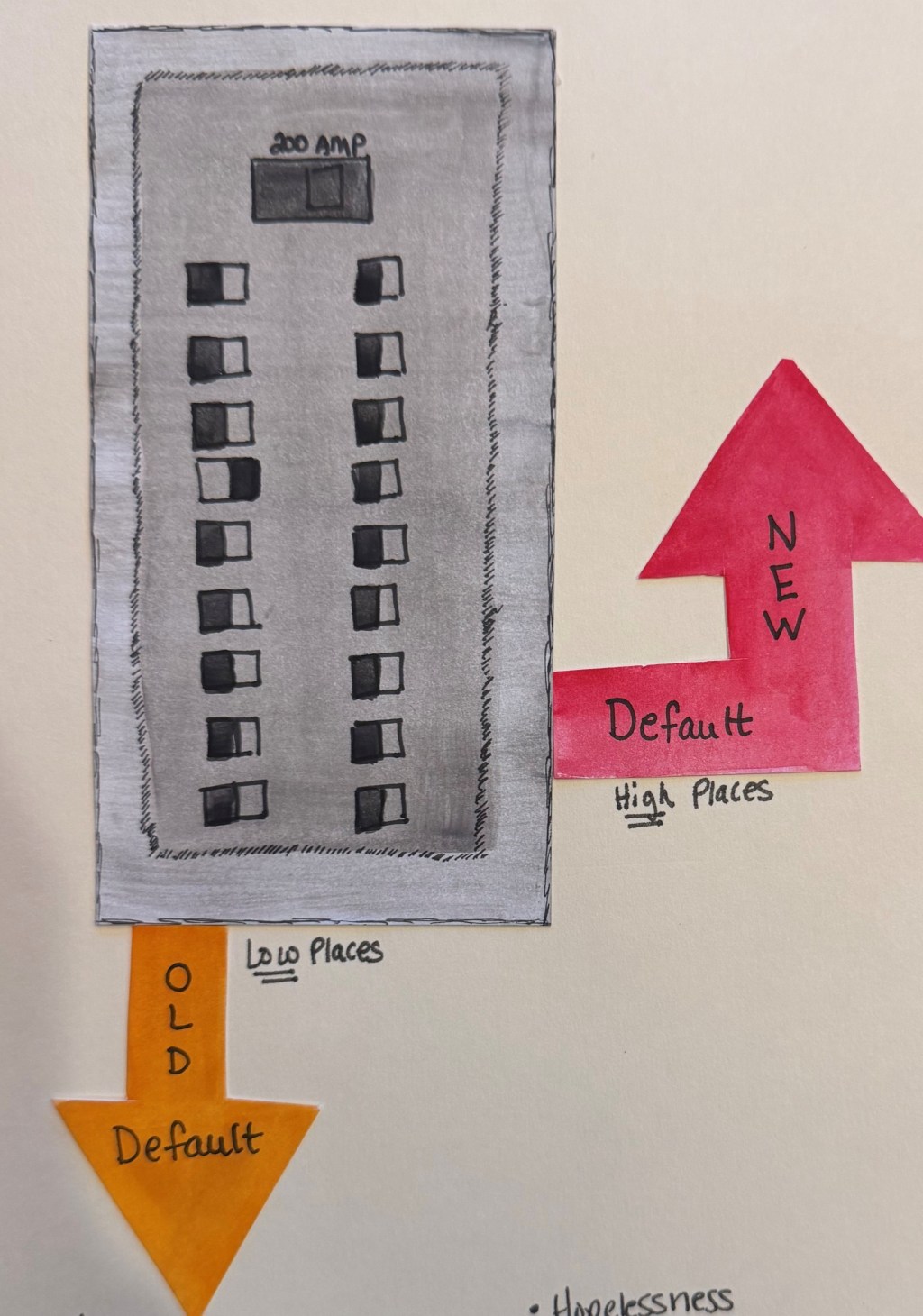
I can’t run my microwave at the same time as my air fryer. Every time I do, the breaker pops and I have to head down to the basement to flip the breaker switch back to the “on” position. Once back upstairs, I have to choose whether I want to use the microwave or the air fryer first—or I’ll be descending the stairs again to repeat the process.
I can’t help but think about my life and the similarities between this scenario and my day-to-day. Just like a circuit breaker trips when the load exceeds the system’s capacity, our hearts have limits. When the pressure builds long enough, something inside us flips.
Things in life “trip my breaker” more often than I’d like to admit.
It could be worry about an unknown thing in the future. It could be the pressure of the number of things I have to do, compared to the hours I have to complete them. It could come from intense emotions that threaten to take me down, or it might even be simple mental exhaustion and the thought of making one more decision in the day.
Breakers serve a purpose. They trip when the electrical demand is greater than the circuit can handle. The breaker shuts off to prevent a fire. In the same way, the feeling of overwhelm can alert us to a problem so we can pause, evaluate, and make different choices moving forward.
Just like my microwave–air fryer situation, the breaker popping tells me I need to do something different or the circuit will get overloaded again.
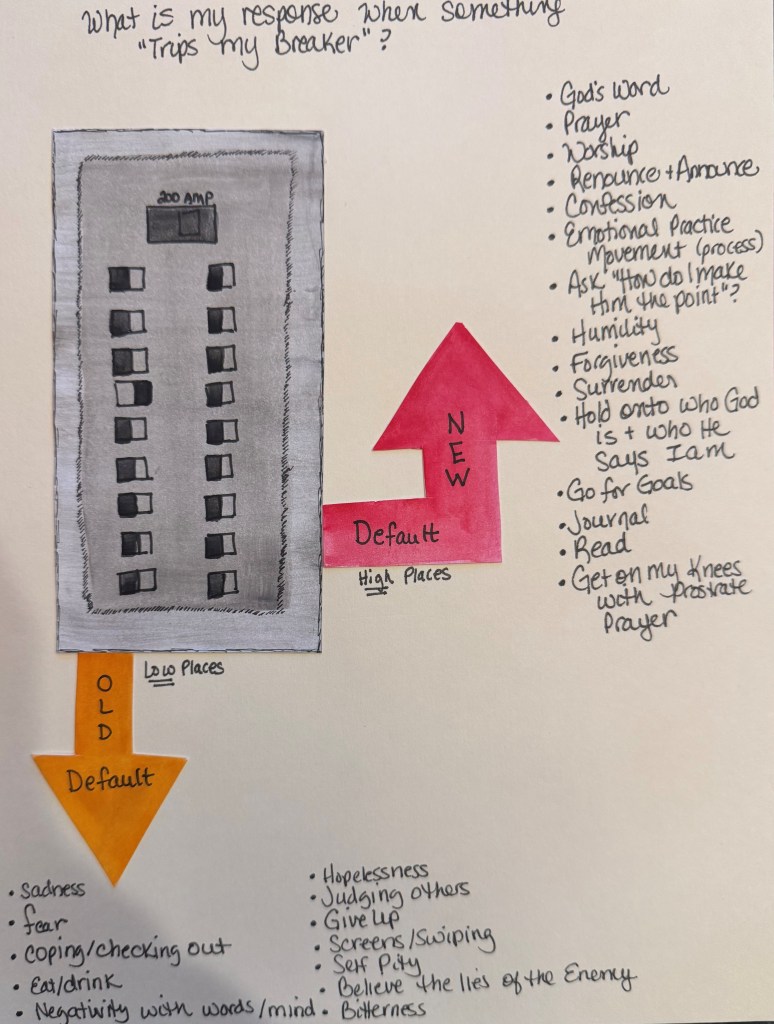
The truth is we all have things that push us past our limits and leave us feeling overwhelmed—and we all have default responses when that happens. When I’m overwhelmed, it’s easy for my flesh to take front and center stage, and therefore my defaults are not always honoring to God, myself, or others. We are human and God doesn’t expect perfection, but I believe He has something so much better for us than the defaults of the flesh that cause us to “go low.”
My default emotional responses can look like sinking into sadness, self-pity, fear, negativity, hopelessness, or discouragement. My actions—which are a direct connection to my heart—might look like eating or drinking in an effort to numb, swiping or vegging out in front of a screen, overworking, complaining, isolating, avoiding responsibilities, or snapping at the people who have the great pleasure of my company.
When our breaker trips, we all have default responses. Some of us shut down. Some escape into distractions. Others try to tighten control and push harder. Some react emotionally, while others freeze and can’t decide what to do next.
The breaker pop is actually an invitation.
But what if the breaker popping isn’t just an inconvenience? What if it’s an invitation? Instead of reacting out of habit—shutting down, escaping, snapping, or trying to control everything—what if the moment our internal breaker flips is actually an opportunity to pause and turn to the One who knows our limits better than we do?
I love the idea of hard things being an invitation. I want my default to be a reminder that I don’t have to do life on my own—that God is with me and wants to grow my character through difficulties. I could seek God by opening His Word or by praying. I could lay prostrate on my exercise mat and confess my sins and my need for Jesus to meet me right where I am. I could ask the Holy Spirit to fill me. I could journal, worship, or simply sit quietly in His presence.
God never designed us to carry every load on our own. Sometimes the overload is simply a signal that it’s time to reconnect to the true source of power. Our hearts grow faint. This world and all the crazy things we encounter make our hearts go low. We need to be lead to the Rock that is higher than ourselves.
“From the ends of the earth I call to you,
I call as my heart grows faint;
lead me to the rock that is higher than I.”
—Psalm 61:2
“Do you not know? Have you not heard?
The Lord is the everlasting God,
the Creator of the ends of the earth.
He will not grow tired or weary,
and his understanding no one can fathom.
He gives strength to the weary
and increases the power of the weak.
Even youths grow tired and weary,
and young men stumble and fall
but those who hope in the Lord will renew their strength.
They will soar on wings like eagles;
they will run and not grow weary,
they will walk and not be faint.”
—Isaiah 40:28–30
He gives us wisdom and strength to choose the high places. Our new default lifts rather than lowers. It reminds us that we are loved and that there is hope and a future. Our God is bigger than anything we could possibly encounter, and He meets us right where we are.
That breaker pop—the feeling of overwhelm—is actually a gift. Because if we let it, we get to know our Heavenly Father in a deeper way as He leads us to the high places.
Next Steps: Let’s Get Practical and Learn to Apply
SPIRITUAL PRACTICES
Check out the story of Elijah, the prophet. He was overwhelmed. After defeating the prophets of Baal, he found himself running for his life, completely spent, filled with fear, and emotionally drained. In his despair, he even asked God to take his life.
But God met him where he was. After a rest, an angel provided for Elijah’s physical needs, and then God brought him to the mountain to reveal Himself in a gentle, transformative way. God also appointed Elisha to come alongside Elijah, reminding him that he wasn’t meant to face life’s challenges alone.
There is so much to learn in this story. Take time to read 1 Kings 18 and 19 several times, letting the story sink in and speak to your heart.
Grab a journal and a pen, and ask God to help you see the truths in Elijah’s story—how God cares for you in moments of overwhelm, provides for your needs, and brings people alongside you to help carry the load.
MENTAL AND EMOTIONAL PRACTICES
Overwhelming feelings can easily take over, and sometimes we lose touch with reality as we spiral into fear, anxiety, or panic. When our internal breaker trips, it’s a signal that we need to pause and reconnect—to God, to ourselves, and to the present moment.
Try this grounding exercise when you feel flooded by overwhelming thoughts or emotions:
Look around and name:
- 5 things you can see
- 4 things you can feel
- 3 things you can hear
- 2 things you can smell
- 1 thing you can taste
As you do this, take a moment to invite God into the pause. Acknowledge Him as the Rock higher than you, and let Him hold your fears, your anxiety, and your overload. With each sense you notice, remind yourself that He is present, He gives strength to the weary, and He meets you exactly where you are.
This simple exercise becomes more than grounding—it’s a reminder that even when our breaker trips, we don’t have to face the flood alone. God is there to steady the circuit, calm the surge, and lead us to the high places of peace and perspective.
PHYSICAL PRACTICES
Lace up your tennis shoes and step outside—into nature if you can, even if it’s just a walk around the block. If possible, find a forest preserve, a body of water, or any place where natural beauty surrounds you.
Moving in nature is healing. Breathe deeply, filling your lungs with fresh air. Center your mind and heart on God. One practical way to do this is by taking a gratitude walk—because there is so much in life to be thankful for.
- Look around you with a thankful heart and notice the beauty in your surroundings.
- Turn your attention to the people who have made a difference in your life.
- Focus on who God is and how He has met you in your journey.
- Reflect on past experiences that were difficult but ultimately used for good in some way.
As you walk, let gratitude guide your thoughts, your heart, and your steps. Each moment becomes a chance to acknowledge God’s presence, appreciate His gifts, and let your soul be renewed.
RELATIONAL PRACTICES
Grab a friend and serve together. The truth is, we aren’t the only ones who feel overwhelmed—some people are facing even greater struggles than we are. When we step out to help someone else, it reminds us that we aren’t alone in our struggles and that God is present in the lives of others as well.
Healing often comes through relationship, and serving provides a powerful opportunity to take our eyes off ourselves. By giving our time, energy, and compassion, we not only bless others, but we also allow our own hearts to be refreshed and renewed.

Leave a comment