I’m going to give a shout-out to my junior-year English term paper: A Tale of Two Cities by Charles Dickens. As I wrestled with the topic of our busy lives in today’s world, my mind wandered—as it often does—to the tried-and-true cup analogy.
I thought about the phrase “my cup is full.” The more I sat with it, the more I realized it can hold two diametrically opposed meanings.
Sometimes we use it to describe a good kind of fullness—contentment, satisfaction, a sense of purpose and sufficiency. Other times, it points to something far less healthy: being overtaxed, stretched thin, or pushed well beyond what we were meant to carry.
Same phrase. Same cup. Completely different realities.
And so, I want to tell you the tale of two full cups.
Cup Number One: The Cup of Motion
From the moment the snooze button is hit for the third time to the final doom scroll of the night, this cup is constantly being poured into—while also pouring out. The pour-in includes responsibilities, a state of stress, goals, and pressure, which fill it to the brim. And when it’s bumped, what spills out is anxiety, irritability, burnout, and exhaustion.
It’s about as appealing as a cup of coffee with cream that’s turned into a bad science experiment—mold and all, the unmistakable evidence it’s been abandoned for days.
These days are packed with endless commitments, moving from thing to thing without margin. There is no pause—only momentum. By the end of the day, emotional fatigue sets in. The response is often numbing: zoning out to the latest Netflix series or reaching for something to forget the weight of the day.
There is no space to take a deep breath.
Flit here. Flit there.
Never fully present because the mind is already racing ahead to the next five things on the plate.
It all feels like too much.
This cup is full—
not because it holds what matters,
but because it is trying to hold everything.
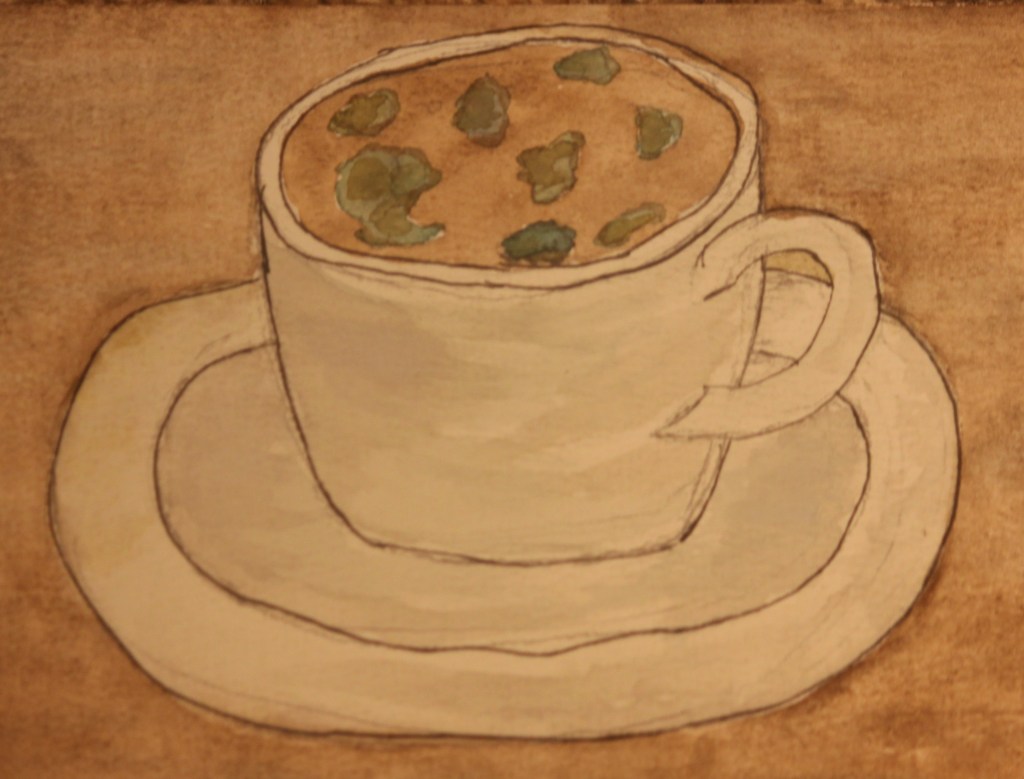
Cup Number Two: The Cup of Meaning
Purpose and meaning drive the life of Cup Number Two.
Like the first, this cup is constantly being poured into—and constantly pouring out. It still carries stress, goals, responsibilities, and pressure. But the contents are different, and because of that, what spills out when the cup is bumped is different too.
This life has commitments, but alongside responsibility there is margin—space to connect with the Lord and to be present with oneself. It is a life intentionally built with blank space. The day begins more slowly, grounded in what matters most, attaching meaning to the tasks ahead rather than rushing past them.
Obligations are filtered, not accumulated—measured against values, calling, and vision. There is room to pause, to pray, to reflect. What is poured into this cup is not merely an endless stream of demands, but God’s presence, His purpose, and His peace.
And when this cup is bumped, what spills out is not anxiety or exhaustion. More often, it overflows with steadiness, trust, and joy.
“You make known to me the path of life;
in your presence there is fullness of joy;
at your right hand are pleasures forevermore.”
— Psalm 16:11 (ESV)
This cup is full—
not because it holds everything,
but because it holds what matters most.

The contents of the cup matter.
When God’s Word informs what I allow into my cup, it becomes a life–giving liquid. It is far better than the toxic contents the world pours in.
I have to ask myself if I am truly filling my cup with God’s truth. Am I intentionally pouring in Scripture, worship, and prayer, or am I hoping they’ll somehow squeeze in around everything else?
Questions swirl in my mind…Do the people I interact with point me to God? And more importantly, do I point them to God?
Do I fill my days with the world and its definition of success? Or do I focus on the things that matter in the scope of eternity? What defines success for me?
Am I spending a significant amount of time filling up on social media, news, and entertainment? Do these often leave me restless, distracted, and anxious?
How do I pour out? Am I serving those around me? Do I stop to care about others? Do I look them in the eye? Or am I too exhausted from running the rat race to notice? Can I say hello to a toddler at the grocery store? Or check on a neighbor to see how they’re doing?
Are my kids enrolled in every extracurricular activity because they might miss out? Do I realize they might be missing out on something far better like family dinners and the simple joy of just being home together?
Every yes is a no to something else. and conversely, every no is a yes to something else. We need to decide which of our yeses and nos truly fill our cups—and which ones are actually depleting us.
Dickens’ words eerily describe our current American culture and capture the plight of the overfilled cup.
Here are the first few lines of Dickens’ classic, in case it’s been a hot minute since High School English:
“It was the best of times, it was the worst of times, it was the age of wisdom, it was the age of foolishness, it was the epoch of belief, it was the epoch of incredulity, it was the season of Light, it was the season of Darkness, it was the spring of hope, it was the winter of despair, we had everything before us, we had nothing before us, we were all going direct to Heaven, we were all going direct the other way – in short, the period was so far like the present period, that some of its noisiest authorities insisted on its being received, for good or for evil, in the superlative degree of comparison only.”
— A Tale of Two Cities, Charles Dickens
We have more knowledge, opulence, light, and comfort than any society before us. And yet, in our post-modern era, truth is often dismissed. Darkness still invades our minds and hearts. We have more than we could ever use. We seek pleasure and comfort—and remain unhappy.
More has become less.
We have less time for what truly matters. We’re too busy to open our Bibles, too pressed to serve those in need. Our schedules are jam-packed, yet we somehow have time to endlessly scroll, passing the moments rather than living them.
I have to ask: what are we trying to avoid by over-stuffing our lives? Are we drowning our schedules—and our minds—so that we don’t have to look within?
In our culture, we want more: more experiences, more possessions, more commitments, more work hours, more food, more efficiency. We multitask as we cram our schedules full. And then, at the end of the day, in response to over-commitment and burnout, we collapse—doom scrolling, streaming, numbing ourselves.
Our cups seem to be full and are overflowing, but in reality they are really quite empty.
Jesus had a lot to accomplish in his short time on earth. His public ministry only lasted about three years. He taught and healed. He mentored his disciples and walked everywhere he went. He performed miracles, asked great questions, and listened. He cared about people and challenged the religiosity of the day.
He changed the world, and yet He took time away to be with His Heavenly Father. Jesus was fully God and fully man. He needed to take time away to recharge and reconnect with His father. That begs the question, how much more do we need to?
Luke 5:16 “But Jesus often withdrew to lonely places and prayed.”
Every day, we have the opportunity to allow God to pour Himself into our cups. Our choices matter—every single day. What we pour in will inevitably come out.
Our cups will be full either way. The real question is: What will they be full of?
Next Steps: Application
SPIRITUAL PRACTICES
Read through the New Testament book of Luke. Pay attention to how Jesus lives with intention. Notice the purpose in every part of His life.
Read slowly and thoughtfully, watching how Jesus lived, and let His life guide your own rhythms and priorities.
- Notice how He rests, withdraws and prays.
- Notice His rhythms that include both busyness and rest.
- Notice how Jesus interacts with people.
- Notice how dependent He is on His Heavenly Father.
MENTAL AND EMOTIONAL PRACTICES
A time audit and responsibility audit can be helpful when looking at the issue of over-commitment.
Time Audit
- Track your time (without changing it or judging it) . See where it is going (sleep, work, commute, volunteer, phone/social media, other screen time, family time, chores, spiritual practices, exercise, etc..).
- Evaluate which things are life giving, neutral or draining
- Prayerfully evaluate your current schedule. Are things that can be tweaked to give you margin and allow you to make life-giving choices in your schedule?
Responsibility Audit
- List out all your responsibilities (work, family, volunteer, kids, household, social, church, personal expectations, etc..)
- Ask yourself if this is something that you feel God called you to or something you just said “yes” to.
- Ask yourself whether your responsibilities align with your values and vision.
- Ask yourself whether these items fill your cup or empty it.
- Ask yourself whether these things matter in the light of eternity.
- Pray and ask the Lord if this is right for this season in your life. Especially pay attention to any questionable commitments.
- Keep-clearly aligned and life giving.
- Limit– it’s good, but needs boundaries.
- Pause-for a season
- Release– no longer mine to carry
- Ask the Lord to show you the things that you can gain in the release: such as: quiet, time in God’s Word, margin, family time, family dinners, game nights, hobbies, and serving,
- Schedule the things that are life-giving and matter, or they will be crowded out with the things that steal our time, energy and resources.
PHYSICAL PRACTICES
Rest and Sleep are two interrelated things that are both of great value. Sleep restores the body and rest restores the soul. Take some time to evaluate how you can make sure your sleep and rest
Rest: Anything that restores what has been drained in the course of life.
- Quiet
- Connecting with God through prayer, Scripture, worship, and other spiritual practices.
- Slowing Down
- Alone time
- Time with life-giving people
- Sensory Rest away from technology
Sleep: When your body and brain shut down to repair itself physically and neurologically.
- How is your sleep quality and quantity?
- What can you do to improve your sleep?
- Do you have habits that interfere with your sleep? (Screens/blue light at night, over-stimulation before bed, a wired brain that can’t shut off, excessive caffeine/sugar, alcohol, worry, inconsistency of bedtimes/wake times, etc..)
How is your sleep? And Just as importantly, how is your rest?
What is one thing you can put into practice this week to bring better sleep and rest to your life?
RELATIONAL PRACTICES
We are made for community, and so often we trade fake community for the real deal. Grab a friend and stop and slow down. Get some coffee or go for a walk and talk. Encourage each other. Discuss what you’re learning. See if you can support each other. Find a balance in life that includes some margin and rest.


Leave a reply to exuberant760f3af5da Cancel reply