This post is part of a series. If you haven’t yet read “A Journey to Health: An Invitation to Walk Through the “Fair” Differently,” you may want to start there. Click the link below to get a better understanding of where we’re headed with this series.
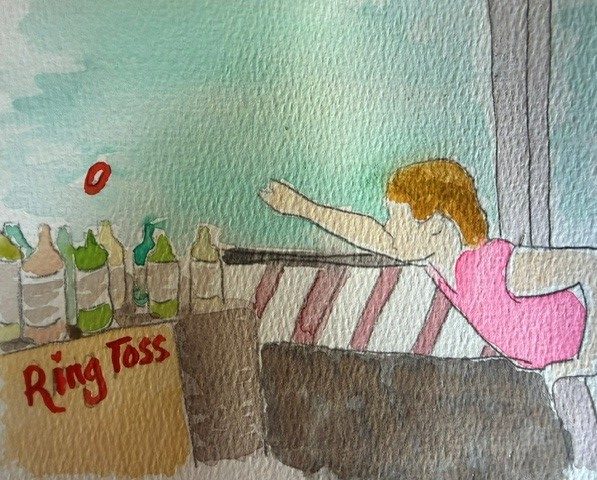
You bought 10 tickets to play the ring toss on the midway. That big Tweety bird the size of St. Louis is calling your name.
Throw 1… so close.
Throw 2… almost!!!!
Throw 3… missed completely.
Throw 4… Here. Take my tickets. This game is stupid. I’m going to get some deep-fried Oreos and a Lemon Shakeup.
Okay, maybe you wouldn’t actually say that. But how often do we do something similar in other areas of life?
We try. We get close. We miss. We try again. And eventually, frustration creeps in.
Forget it. I’m just not good at this.
I’ll never be able to stick with it.
If I can’t do it right, why bother?
Sometimes what looks like a motivation problem is actually a mindset problem. And sometimes hiding underneath our mindset is a little thing called perfectionism.
We can become so focused on getting it right that a few misses convince us to walk away altogether.
But what if missing the ring doesn’t mean you failed? What if it simply means you missed?
There’s still another ticket in your hand. And maybe the question isn’t, “Am I going to get this perfect?” Maybe it’s, “Am I willing to take the next throw?”
That dang all-or-nothing mentality used to get me every time. If I messed up my rigid plan, I didn’t handle it well. Understatement of the year.
It was as if I got a flat tire and then decided to go around slashing the other three tires on my car.
Who in their right mind would EVER do that? And yet, this can be very normal dieting behavior.
We live under rigid rules and eventually, we’re almost looking for a way out. The rules are hard. The dieting mentality is exhausting. Motivation comes and goes. We feel deprived. And when we finally step outside the lines, instead of simply getting back on track, we punish ourselves by throwing the whole plan out the window.
Well, I already messed up. I might as well (fill in the blank)….You know how the rest of that sentence goes.
But what if caring for our bodies didn’t feel like punishment? What if the goal wasn’t to follow a rigid set of rules perfectly, but to learn to steward the body God has given us well?
There’s a big difference between restriction motivated by shame and choices motivated by stewardship. Read that one more time. Seriously…read that again.
One says, “I have to be good.”
The other says, “I want to care for what God has entrusted to me.”
One makes a missed throw feel like failure.
The other simply picks up the next ring.
Perfectionism ties our sense of worth to making everything “just so.” The focus is on self. What if we believed that the next right step was more important than doing everything optimally at all times?
We attach our sense of success, worth, safety, or identity to getting things just right. The problem isn’t the desire to do well; it’s the belief that anything less than perfect is unacceptable.
That can create a cycle.
We’ve got massive expectations—either of the process or the results. We put immense pressure on ourselves to do the 1,000 new changes we’ve decided to add to our day perfectly on the very first day… and every day after that.
And when we don’t (which is bound to happen)?
Watch out. Logic gets completely tossed out the window.
Instead of simply adjusting our course and continuing in the same general direction, we hightail it—running as fast as we can in the completely opposite direction.
We wallow in shame and discouragement because we let ourselves down. Then, eventually, we come up with a new plan—probably with those same unrealistic expectations—and the cycle begins again.
But what if we interrupted that psycho cycle?
What if we made our expectations a little more “fun-sized?”
What if we stopped torturing ourselves with unrealistic, harsh standards rooted in comparison, competition, trying to measure up to someone else’s expectations—or even our own self-loathing?
What if we approached our bodies as a gift from God?
What if I viewed my body as good—not because it is perfect, but because it was created by a good God?
What if I focused on stewardship rather than punishment?
What if I viewed my health or weight challenge as an opportunity to learn what it looks like to rely on God in my weakness rather than relying solely on my own willpower?
Paul writes:
“He who began a good work in you will carry it on to completion…” — Philippians 1:6 NIV
Trust me, I know this verse isn’t specifically about weight loss. In context, Paul is talking about the work God is doing in believers—the ongoing work of sanctification.
And that’s actually why I think it belongs here.
Sanctification involves becoming more like Christ, including learning to recognize and put to death the sinful desires of our flesh and learning to walk by the Spirit. The “works of the flesh” Paul describes in Galatians are much broader than how we care for our bodies.
But here’s where I think it gets interesting:
Even something as ordinary as caring for my body can reveal what is driving me.
Am I being driven by shame? Comparison? Vanity? Competition? Control? Fear?
Or am I learning to make choices from a place of gratitude, wisdom, self-control, and stewardship?
The goal isn’t to create another rigid set of rules that I have to follow perfectly.
The goal is to become increasingly attentive to God and increasingly willing to let Him transform the way I think, choose, and live—including the way I care for this body He has entrusted to me.
That’s a much different journey than trying to finally become “good enough.”
And thankfully, I’m not doing the transforming myself.
He who began the good work is still at work, and I get to participate in what He is doing. Part of that good work may simply be learning to pick up the next ring and toss it to the best of my ability—even after I’ve missed the mark.
I don’t have to throw a ringer every time.
I just need to be willing to pick up the next ring.
Next Steps: Take the Next Throw
SPIRITUAL
God is perfect, and I am not.
So how about we lean into that undeniable truth?
What should my response be to a perfectly holy God?
Bow down in reverence and worship.
Own my sin through confession.
Go to Him for wisdom and strength.
These are three ways I can lean into the reality that God is perfect and I am not.
I don’t have to pretend I’m perfect.
I don’t have to punish myself for being imperfect.
And I certainly don’t have to run away from God because I’ve missed the mark.
Lean in.
Bow down. Confess. Ask for wisdom and strength.
The God who is perfect isn’t asking me to become perfect before I come to Him. He’s inviting me to come as I am—and to let Him continue His good work in me.
EMOTIONAL
Perfectionism can be a strategy for avoiding uncomfortable emotions.
If I believe “I must do this perfectly,” I get a temporary sense of control. But when I inevitably fall short, I experience disappointment, shame, frustration, or fear. Then I may either try even harder to regain control or quit entirely to escape the discomfort.
What uncomfortable emotions come to mind as you examine perfectionism related to weight loss and health?
MENTAL
So often, we don’t even recognize the thoughts swirling around in our heads. We let them set up camp. Then they build a dwelling, and before long, we’ve given them a permanent address.
Let’s catch those thoughts that aren’t serving us well and evict them.
Get out a sheet of paper and go to town.
Write down those thoughts.
Get them out of your head where you can actually look at them. Which ones are true? Which ones are rooted in fear, shame, comparison, or unrealistic expectations? Which ones need to be challenged with the truth of God’s Word?
We don’t have to give every thought a permanent place to live.
In Christ, we are free to bring those thoughts into the light, replace lies with truth, and walk forward without being held captive by perfectionism.
PHYSICAL
The practice this week is to take the next right step after making a mistake.
That may mean going for a walk in the evening even though there’s no way you’ll hit your step goal for the day.
It may mean having a healthy dinner without overindulging, even though you had ice cream for breakfast.
It may mean doing the workout you planned, even though you missed yesterday.
Basically, don’t wait until tomorrow. Don’t wait until Monday. Take the next right step right now.
You missed the mark? Pick up the next ring.
You don’t have to make up for what happened. You don’t have to throw the rest of your tickets away. You simply get back in the game and take the next right step of faithfulness.
RELATIONAL
Find someone you trust and get honest.
Not someone who will shame you when you miss the mark. Someone who will listen, encourage you, pray with you, and lovingly ask the questions you might not ask yourself.
Research has found that the people who wrote down their goals and regularly reported their progress to a friend achieved significantly more than those who simply kept their goals to themselves.
So who is your person?
Who can you be honest with—not just about the wins, but about the ice cream for breakfast, the missed workout, the emotional eating, or the day when you simply didn’t follow through?
Accountability isn’t about perfection. It’s about refusing to hide when you miss the mark.
When you stumble, tell someone. Then pick up the next ring and take the next right step.

Leave a Reply