My sourdough starter was named Eve. She was thriving… until the day my jar tipped over in the fridge and, in one tragic moment, Eve left this world.
Gone. Just like that.
I’d like to say I handled it well, but there was definitely a brief moment of staring into the fridge, wondering how something so alive could meet such an untimely end.
But here’s the thing about sourdough starters—they multiply. Before Eve’s untimely demise, I had shared some of her with friends and family. They shared with others. Apparently, Eve had been fruitful and multiplying this whole time.
So while my jar was empty, Eve was very much still out there… living her best life in other kitchens.
Eventually, my daughter-in-law gave some back to me, and we started again.
We debated what to name this new starter, and after some discussion, we landed on Ruth.
It just felt right.
Eve may have been the beginning, but Ruth? Ruth is about loyalty. Ruth is about coming back. Ruth is about, “Where you go, I will go”—which, in this case, apparently includes traveling through multiple households and returning to my kitchen.
So here we are. Ruth is alive and well.
And this time, I’m keeping a closer eye on the jar.
Sourdough has become woven into the fabric of our family and daily life. There are so many lessons in it, and the connection to bread, leaven, and transformation naturally turns my thoughts toward faith analogies.
As part of the “I am” statements in the book of John, Jesus says, “I am the bread of life.” (John 6:35). He sustains us and nourishes our souls, satisfying what is empty within us. I love that He uses the analogy of bread because it points to the ongoing nature of a relationship with God.
Just as we need daily food, we need to be spiritually fed every day.
The Bible also speaks about leaven—an influence that spreads. A starter contains leaven, and it works its way through the dough, causing it to rise and giving it its distinctive flavor. During Passover, the Israelites were instructed to remove all leaven from their homes as a symbol of purity and the removal of sin.
As Paul writes, “Do you not know that a little leaven leavens the whole lump of dough? Clean out the old leaven so that you may be a new lump… For Christ, our Passover lamb, has been sacrificed” (1 Corinthians 5:6–7). That is how sin is, pervasive and spreading. Jesus Christ was sacrificed so we can life a new life, not the old life defined by sin.
Interestingly, Jesus flips the image and compares the Kingdom of God to leaven in Matthew 13—something small that quietly works through everything from the inside out. The point is the same: the Kingdom of God is an influence that spreads, giving a distinctive flavor and a rising above.
I’d rather have the leaven of the Kingdom of God growing in my heart than the leaven of my sinful nature, quietly rising within me and shaping every part of who I become. The outcome of the type of leaven is 180 degrees different.
What about you? What kind of leaven is growing in your life?
As I think about the quality of the ingredients, the process of fermentation, the timing of stretch and folds, and the long, slow rhythm of time it takes to make a loaf, I’m reminded of my own life. There is a lot of waiting, patience, and learning, and what I allow in matters. Just as simple flour, water, and salt (along with tiny yeast and bacteria) are transformed into something entirely new through shaping and heat, the same is true for us.
The heat changes us—what feels intense in the moment is often what brings the deepest transformation. Isaiah 48:10 says, “I have tested you in the furnace of affliction.” Suffering is often equated with heat because it is uncomfortable, yet heat also reveals what is inside. The Bible repeatedly describes times of difficulty—where we are forced to trust God—as the testing of our faith. These moments expose what is in the heart. For some, suffering leads to the abandonment of faith, while for others it deepens and strengthens their relationship with God.
Heat metamorphizes. Dough becomes a loaf of bread in the oven. That bread can’t ever become dough again. It’s been transformed.
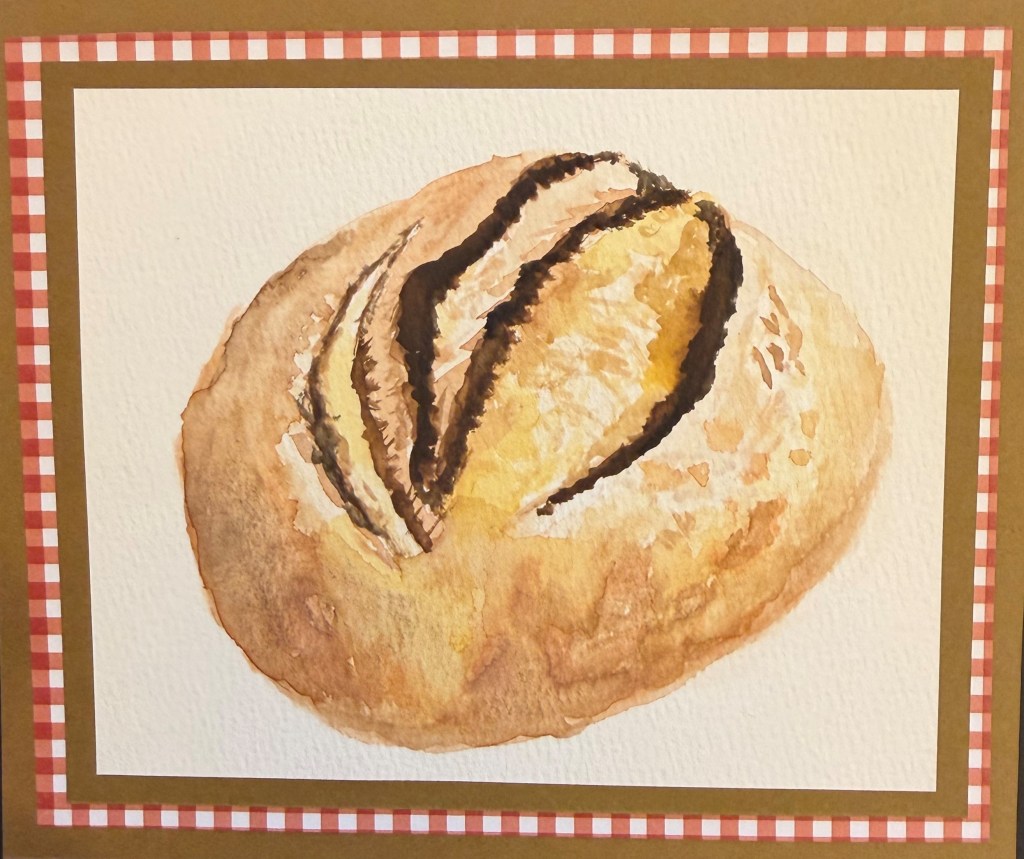
No one signs up for suffering, but even through the hardest seasons, the transformation God brings in us can become exactly what He uses to shape us into who He wants us to be. What we would never choose can become the very place where He does His deepest work.
Back to Eve. I named her Eve because she was the “mother of all who have come after her,” and as I began sharing my starter, I saw that sense of multiplication lived out.
As I reflect, Eve’s story—like sourdough—has both a rise and a fall. She was the pinnacle of God’s creation, beautiful and whole. She communed with God face to face and lived in the fullness of His presence. We can hardly imagine what the Garden of Eden was like, or what it means to exist in complete purity and sinlessness.
And yet, she also experienced the fall. We only know life after the fall, but she knew life before it. Can you even imagine the transition—from purity and communion with God to emotional, spiritual, physical, and relational brokenness? From blessing to curse in a single moment. The rise… to the fall.
But the fall is not the end of the story. What was broken in Eve’s beginning is not beyond redemption in God’s hands. In Christ, there is restoration, forgiveness, and new life being formed even now. What was lost is not discarded—it is carried forward, often in ways we do not expect, until it becomes something new.
Eve’s story reminds us of what was. Ruth’s story reminds us that life can be passed on, received again, and begun anew. And ultimately, Christ is the One who redeems both the rise and the fall—bringing life out of what seemed finished and beauty out of what was broken.
Next Steps: Application
Spiritual Practices
When making sourdough, it takes about 24 hours to make a loaf, but almost all of that time is rest. We’re going to explore the spiritual discipline of rest.
Our hurry culture doesn’t value rest. What does God say about the concept of rest?
I want you to search the Scriptures to see what God says about rest. Some key words would be Sabbath and rest. Use a concordance or do a google search. Spend some time coming up with a theology of rest and then take at least one step this week to implement this core concept.
Some questions to explore: Why do we avoid rest? What are we telling God when we disobey? How do rest and trusting God go together?
Emotional and Mental Practices
We’ll call this the “What’s rising in me challenge.”
Pick a time of the day that suits you best. Check in with yourself and ask yourself each day the single question, “what’s rising in me?” Is it hope, doubt, fear, anxiety, victim mentality, blame, self-pity, peace, bitterness, trust?
If it’s something that you want to rise, feed it.
If it’s something that you don’t want to rise up in your life, confess it and ask the Lord for the next steps to let the leaven of the Kingdom of Heaven grow instead of the sinful nature.
Physical Practices
The physical act of breadmaking brings this whole point home on a deeper level. I would encourage you to try making a loaf of bread from scratch—whether sourdough or a traditional yeast loaf. As you knead, stretch, and fold the dough, as you patiently wait for it to rise, and as you place it in the oven, ask God to show you more of Himself—His patience with you, and His tender love as He molds you into the image of Christ.
Relational Practices
If you make homemade bread, share some. Look for ways to minister to others—whether by inviting someone over for a meal or bringing a loaf to a neighbor. God calls us to love one another well, and often that love is expressed through simple acts of hospitality. He even uses something as ordinary as breaking bread together to build connection, fellowship, and care.

Leave a Reply