I’m a child of the seventies.
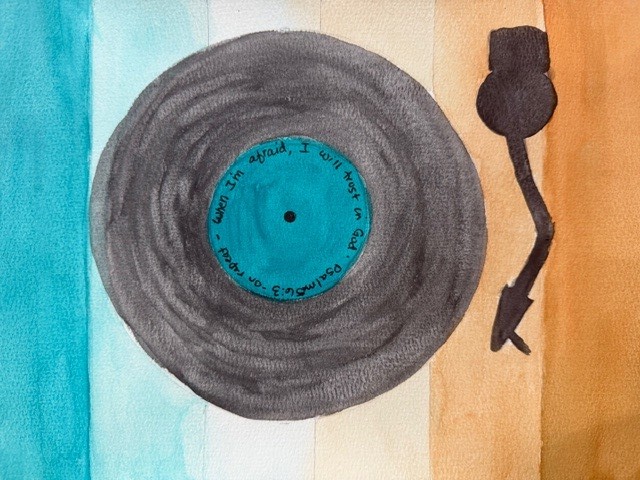
One of my favorite things to do as a kid was crank up the stereo, drop the needle on my favorite records, and climb up on the fireplace with my sister. Microphones in hand, we’d sing and dance like we were on stage, the black vinyl spinning, filling the room with the soundtrack of our childhood.
Until it skipped. The needle would catch, and the song would repeat the same line over and over again—turning something beautiful into something frustrating. It’s funny how something meant to bring joy can get stuck like that… just like my thoughts sometimes do.
What once was a song became a frustrating loop.
Isn’t that what fear and anxiety does? It plays the same thoughts on repeat. Our brains are wired to protect us, sounding alarm bells when something doesn’t seem right—but sometimes the needle gets stuck. The same hypervigilant thought loops over and over again.
Fear is a response to what is real and present, while anxiety moves beyond the moment into an unknown future. It takes what is right in front of me and jumps ahead, expanding a current problem into a thousand possible worst-case scenarios. In doing so, it often becomes overwhelming, leaving me feeling paralyzed rather than prepared to respond.
Anxiety is the mind and body’s response to perceived threat—often showing up as persistent worry, racing thoughts, or a sense of unease, even when there’s no immediate danger. The mind gets fixated on the possible worst-case scenarios and unknown dangers.
Anxiety doesn’t need much to work with. It can take something important—our kids, our health, our future—and turn it into a loop of “what ifs” that plays over and over again.
People feel anxious about things that are squarely outside of their control—relationships, finances, the state of the world, regrets, unpredictable situations, health scares. Add in the “what ifs,” and it’s not hard to see how the mind can get stuck replaying it all. You name it, and someone has probably been anxious about it.
But what does the Bible have to say about this broken record that plays in our head?
Philippians 4:6-7
“Do not be anxious about anything, but in every situation by prayer and petition with thanksgiving, present your requests to God. And the peace of God, which transcends all understanding, will guard your hearts and your minds in Christ Jesus.”
Did you catch that? God tells us not to be anxious about anything, but instead to come to Him in a posture of need. We don’t ignore the alarm bells going off in our hearts and minds; we let them become a signal—an invitation to turn and connect with the Lord.
Gratitude is woven into that response. As we bring our requests before Him, we also give thanks, because gratitude fixes our eyes on who He is and reminds us of His faithfulness in the past. When we remember who God is—who He says we are, the stories written on the pages of Scripture, His promises, His character, and His deep love for us—we begin to refocus our gaze. We see our situation from a higher place of clarity and truth.
When anxiety takes over, we shift into the lower, more reactive parts of our brain. The amygdala—our internal alarm system—begins running the show, while the prefrontal cortex, where higher reasoning and thoughtful decision-making occur, becomes less active. Emotional dysregulation takes over.
In that state, we don’t reason clearly or relate well to others. We react instead of respond. Anxiety hijacks our nervous system, pulling us out of alignment with what is true.
The more we allow anxious thoughts to run unchecked, the deeper the groove becomes – like a record stuck on repeat, reinforcing the same fearful patterns in our minds.
Overcoming anxiety, then, is a process of retraining and recalibrating the mind and emotions—returning again and again to what is true until it becomes the louder voice. When we purposefully change thinking patterns, it’s extremely difficult at first. We easily fall into those grooves or ruts of the way we think, but the amazing thing about the brain is that we can intentionally create new neuropathways through repetition so that we have new defaults.
That is why bringing God’s Word together with prayer helps lift us out of that hijacked state. As we turn to Him, our thinking begins to realign. We become grounded in truth instead of being carried away by “what ifs.”
Did you notice the promise at the end of the passage? There is a great exchange taking place. We bring God our worries—on repeat—and He meets us with His peace—on repeat—even in the most difficult of situations.
It’s not a one-time exchange, but an ongoing rhythm: a steady ebb and flow of turning to God in every anxious thought and allowing Him to meet us there. In that meeting place, He restores our minds and hearts back into connection with Him.
That is where peace comes from—it is rooted in Him. In Christ Jesus, He guards our hearts and minds. I like to picture it as having the strongest and most unshakable Guardian who is always with me. If I truly knew who God is, fear would have to flee. But so often the problem is not that God is absent—it’s that I forget the spiritual perspective and get stuck in the minutiae of the here and now.
We remember who God is—His promises, His character—and we intentionally remind ourselves that we are not alone. We have access to the King of Kings, the Creator of the universe, and He loves us. His Holy Spirit dwells within us when we place our faith in Him. We are not left to navigate fear and anxiety on our own.
During a particularly difficult season, anxiety was ramping up within me. My once-calm mind was in overdrive. The challenges in front of me were real—I wasn’t imagining them. But anxiety threatened to pull me down paths of fear on a minute-by-minute basis. I was overwhelmed, to say the least.
So every time a fear, doubt, or worry rose up, I went to God—face down on my exercise mat. Prostrate before Him, I breathed, I prayed, I cried. I cried out to the Lord. I recited His promises—that He is near when I am afraid, that He will never leave me or forsake me. I thanked Him, even when I didn’t feel steady.
Honestly, I wish I had a video of that season. I’d work for a few minutes, and then anxiety would surge, sending me back to the floor. I’d get up, return to my computer, and within moments be bombarded again. Back to the mat I went.
I’m sure it looked ridiculous. But I will never forget how God met me there—in the hundred times a day I called on Him. He answered me. He delivered me from my fears, even if only for a few minutes at a time. The Scripture that I played on repeat was “When I am afraid, I will trust in You.” Psalm 56:3 NASB I’d confess my fear and anxiety each time, asking Him to bring my thoughts back into alignment with God’s Word.
Because that groove—the one causing my thoughts to skip and spiral—was being reshaped every time I turned to Him. Each return was like lifting the needle and setting it back on truth.
At some point, I had to decide: Do I really believe what the Bible says? Do I believe God is who He says He is? Do I trust that He is with me?
The practicality of going to God throughout the day led me to ask a deeper question: Am I relying on my own strength to carry it all, or am I bringing everything I have to Him and trusting Him with it?
And over time, the record didn’t just begin to skip less—it played an entirely different tune, marked by the steady rhythm of Truth and the praise that could not help but rise from my lips as one being freed from fear and anxiety.
Next Steps: Practical Application
Spiritual Practices
Psalm 31 is one of the most raw passages of Scripture. David doesn’t hold anything back before God—he brings his fear, exhaustion, and distress fully into His presence. I think it’s safe to say that he is emotionally at the end of himself.
After reading this passage, I can see why David is described by God as “a man after God’s own heart.” He confides his deepest feelings to the One who already knows it all. He asks for help and repeatedly returns to God’s promises and character. Over and over, I see him speaking to himself—choosing to trust, choosing to rejoice, choosing to go to God and trust Him in all things.
When it all comes down to it, we don’t always get a say in what happens in our lives, but we do get a choice in how we respond. In this passage we see David actively redirecting his gaze to his faith through the midst of difficulties.
There is so much we can learn from this window into David’s heart. Read through the Psalm in your mind. Now, read it out loud with intonation as if you were David pouring your heart out to the Lord.
There is something about using your vocal chords, voice, and ears to deepen your understanding of the emotional distress that David was in.
We see a blend of heaviness, honesty, and hope. It’s as if there is a tug-of-war between despair and trusting God. Isn’t that how life is? It’s not neat and tidy.
Questions:
- After having read this passage out loud, how does this passage make you feel?
- Where was David at emotionally, physically, mentally, spiritually and relationally?
- Can you relate to David’s cry to the Lord? If so, how?
- What emotions do you see? List them out.
- Which character qualities of God are revealed in this passage?
- Do you sense a theme related to God’s character?
- What did David ask of God?
- When you see David being pulled down by his emotions, what are some pivots you see in his prayer? Why is that important?
- What truths does he hang on to?
- How can you apply what you’ve learned?
Mental and Emotional Practices
I love a good brain dump. Anxiety often feels nebulous—like a fog you can’t quite grab onto. One of the simplest ways to begin clearing it is to grab a piece of paper and write down every single thing that comes to mind that is contributing to your anxiety. No judgment. No filtering. Just get it out.
Put it on the page.
These aren’t easy things, but they’re already circling and looping in your mind. Bringing them into the open doesn’t make them bigger—it gives them form. And once they have form, they can be faced, processed, and brought to God with clarity instead of chaos.
Releasing them from your mind and placing them on paper creates space to think clearly again. Here’s a list that might help you in the process. Do any of these things weigh on your mind:
- Relationship tensions
- Financial pressures
- Overwhelming tasks or responsibilities
- Fears
- The “what ifs” replaying on repeat
- Physical symptoms or body tension
- Negative self-talk
- A hurried or overloaded schedule
- Other people’s choices that you can’t control
- Insecurities
- Shame or regret
- Wrestling with trusting God
Now that you have this all on paper, take a breath. I bet it feels like a lot.
This is a good time to grab a highlighter or a pen and begin marking up your page. Truth needs to be your filter. Many of the anxieties circling in your mind are things that haven’t happened—and likely never will. And many of the words speaking to your worth are simply not true.
The goal of this exercise is to begin releasing anxiety and overwhelm. Ask God to help you lay down the things that are outside of your control and to give you clarity for the next steps in front of you.
Pray and ask Him to reveal what is true.
Some helpful filter questions:
- What in this brain dump needs my attention most right now?
- Am I responding to what is real in this moment, or am I being pulled into imagined future outcomes?
- Is there something underneath this sense of anxiety (shame, sadness, pressure, fear, regret, etc.)? Do I notice any patterns?
- What feels at risk right now?
- Where have I seen God’s intervention and faithfulness before in my life?
- Am I viewing this situation through the lens of fear or faith?
- What does God’s Word say about this?
- What would it look like to trust God in this today?
Physical and Relational Practices
Anxiety isn’t just in the mind—it’s experienced in the body as well. What we do with our bodies matters. Here are some habits to evaluate
Sleep & Screen Time
Lack of sleep creates a vicious cycle—poor sleep fuels anxiety, and anxiety makes it hard to sleep. Be intentional about getting good rest. Try taking a break from screens after dinner for a week. Create a simple wind-down routine before bed and see what happens.
Social Media
Comparison is the thief of joy. Choosing not to doom scroll can genuinely change your life. For the past 16 months, I haven’t scrolled social media at all—and I don’t ever want to go back. It’s been life changing.
News Consumption
If you want to fuel anxiety, turn on the news and absorb all the problems in the world—most of which you can’t do anything about. Try stepping away for a time and see if your peace increases. We weren’t meant to carry this much information or process it in real time. It’s too much.
Lack of Margin
A hurried, overloaded schedule ramps up anxiety. Where can you create space? What can you cut back on?
Coping Mechanisms (caffeine, alcohol, etc.)
What are you turning to for a pick-me-up or relief? Is it truly helping, or just masking the problem?
Nutrition
Is your body being nourished or depleted by what you’re consuming?
Activity Level
When was the last time you went for a walk outside? Are you moving your body intentionally? Even small movement can shift how you feel.
Community
Anxiety thrives in isolation. Reach out to a friend. Spend time with people who bring life and encouragement.

Leave a Reply