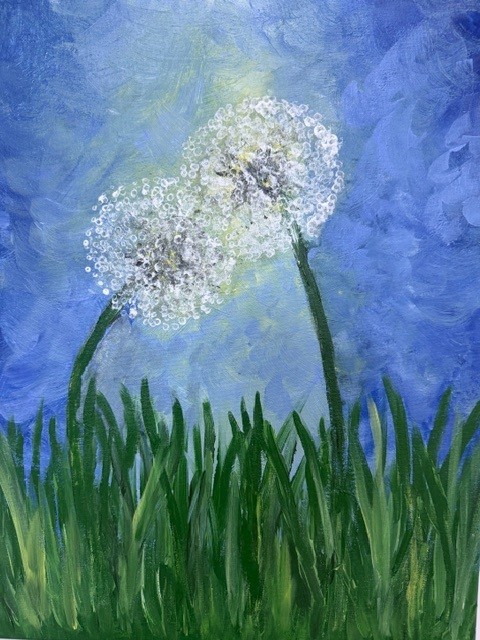
Our home is 130 years old, and I sometimes wonder if some of the dandelions in our garden have been there since the day the masons were slathering mortar on the foundation stones as horse-drawn carriages traversed the dirt roads in our town.
These dandelions stubbornly hang on for dear life when I try to remove them. Year after year, their roots stretch deeper, strengthening their grip on the earth. Like tiny suns scattered across the yard, the dandelion heads are visible from where we stand, but from our limited view, we can’t see how deep its roots truly run beneath the surface.
Hebrews 12:14–15 refers to bitterness as a root:
“Make every effort to live in peace with everyone and to be holy; without holiness no one will see the Lord. See to it that no one falls short of the grace of God and that no bitter root grows up to cause trouble and defile many.”
A bitter root is a deep-seated hurt or resentment that clings to my heart. It’s as if I can’t shake it. It surfaces in what I think, what I feel, what I say, and the choices I make.
Over the course of my life, I’ve had seasons where I’ve been stuck in bitterness in a debilitating way. And if we’re honest—if we’re over the age of two—we all have bitter taproots that want to stretch downward and take hold.
The enemy tricks us into thinking that bitterness gives us power. But the truth is, like any sin, our twisted mind gets it wrong. Bitterness doesn’t strengthen us—it drains us. It becomes a tool the enemy uses to rob our joy, steal our peace, and slowly destroy what God intends for good.
Interestingly, if you were to pull certain roots out of the ground, you’d find that some actually taste bitter—like dandelion root or chicory. Their bitterness serves a purpose—it helps protect them from being eaten. It’s a form of self-preservation.
Pause for a moment and read that again.
Protection.
Self-preservation.
Do we cling to bitterness as a form of protection from being hurt again? Often without realizing it, we build barriers to shield ourselves from pain. Barriers in themselves aren’t wrong—but the heart behind them matters.
There is a difference between healthy boundaries and hardened walls.
Healthy boundaries create space for wisdom and healing, while still allowing the heart to remain soft before the Lord. Bitterness, however, hardens the heart and closes off connection, building what feels like an unscalable wall—one that keeps others out, but also keeps us in.
Bitterness works the same way as roots. The root of bitterness nourishes the growing plant—and this isn’t a plant I want to feed because a dandelion is a weed that spreads. What begins as a bright splash of yellow scattered across the yard eventually gives way to a fragile white sphere. Hundreds of tiny seeds, each designed to catch the wind, can take root somewhere new.
The visible signs of a root of bitterness show up in snarky comments, guardedness, replaying past offenses, unforgiveness, disproportionate reactions, tone, gossip and slander, assuming the worst, passive-aggressive behavior, being easily triggered, and a lack of trust. It’s as if distrust becomes the filter through which everything passes. And just like those dandelion seeds, they land on others passing along the sin, distrust and negativity. And so it goes.
What takes hold in the hidden places will eventually make itself known.
Have you ever met someone who seemed to drip bitterness? After just a few minutes together, something feels off. You can sense that hurt is in the driver’s seat—while hope and gratitude have been pushed out of the car—as they drive through the land of offense. Or, can you admit that has been you or is you? Man, that hits home for me. Conviction is ringing in my heart over the times in my life where bitterness reigned.
Roots help plants grow as they draw up water and nutrients from the soil. The larger the root, the harder it is to pull. That plant is anchored to the soil. It’s not going anywhere. You may not see the root, but you see the evidence—new leaves, bright yellow flowers, and eventually seed heads dotting the turf.
Isn’t that how bitterness works? Some roots grow straight down, while others branch out horizontally—extending like a thousand arms, with fingers stretching outward. Deep and wide, it spreads. It doesn’t stay contained. Bitterness latches onto others through careless words. It spills out. As Hebrews warns, the bitter root “causes trouble and defiles many.”
My heart condition can spread, almost like a virus, to the people around me. My unresolved hurt gets passed on, and in the process my attitude and words create division and disunity.
When we allow a bitter root to grow unchecked, branching outward, we begin to fall short of the grace of God.
And here’s the humbling truth: God has every reason to be bitter toward me. I fail Him daily. I choose lesser things over Him. I give in to my flesh. My focus drifts from a steady gaze on Him.
And yet… He forgives me.
I have offended the Creator of the universe and the Savior of my soul. Still, my sin has been erased through the blood of Jesus shed for me. That is the grace of God.
So when I refuse to release bitterness—when I cling to it like a toddler gripping a beloved blanket—I’m not just holding onto hurt. I’m resisting the very grace that has been freely given to me.
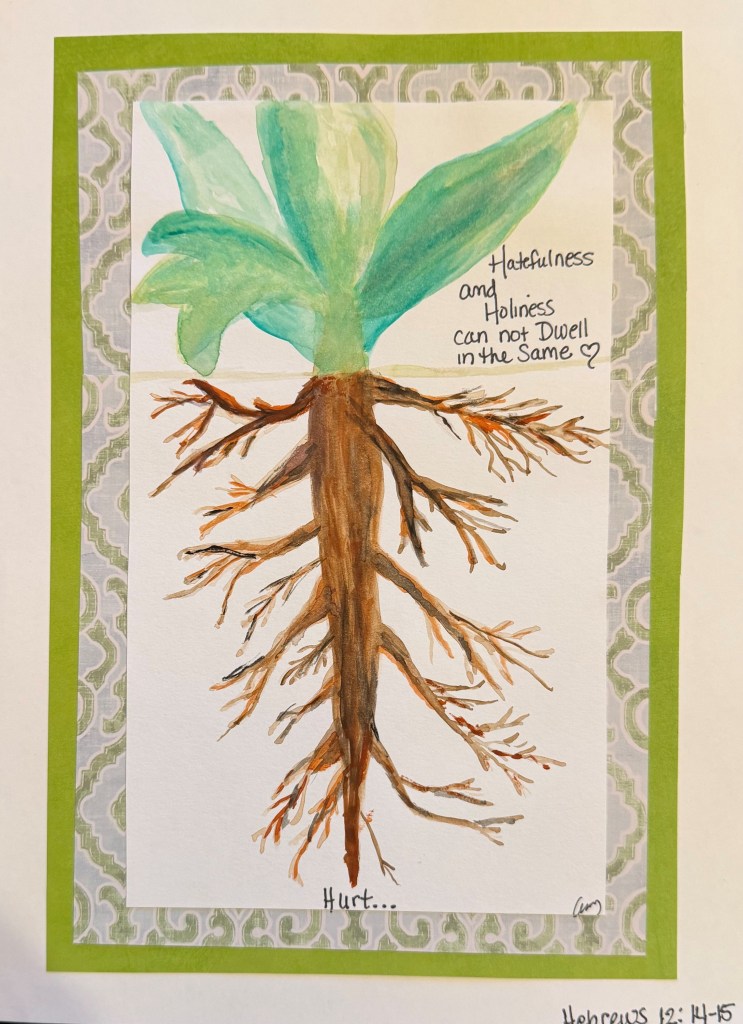
Look at the picture. Notice at the base of bitterness there’s a word: hurt.
Bitterness grows out of unresolved hurt. It’s like simmering anger beneath the surface—stored, waiting, ready to surface at any moment. It can become like a broken record, playing the same offense over and over in the mind—looping endlessly, with no movement toward healing and no desire for growth. The longer it remains, the deeper it settles and the harder it is to remove.
All the while, it grows… while shrinking you—your character, your peace, and your relationship with God.
Hatefulness and holiness cannot dwell in the same heart.
Sometimes people pick a dandelion or other weeds, and from a distance the lawn looks great—for a time. Cutting the flower does nothing to stop the persistent dandelion from coming back. If the root isn’t completely removed, it just keeps coming back. Did you know that dandelions can restart growth and form an entirely new plant from just a small piece of root left underground?
This is a call to remove bitterness fully. Picking the flower from the stem only keeps the landscape green for a moment. Without fully removing the root, it will come back—often with vengeance.
First, I want to say that removing all traces of bitterness is probably beyond our ability on our own. Bitterness has roots that run deep, and we need the Lord to realign our hearts, heal our wounds, and lift our gaze to Him.
He is the only one who can help us pull it up by the root so we can forgive fully. Even when we think we’ve dealt with it, bitterness can resurface, showing that more of the root still remains. In those moments, we need to go to the Lord and let Him dig deeper, carefully removing what we cannot see or reach on our own.
I’d encourage you to check out 2 previous blogs on release and control that speak to this topic.
https://purposefullydesigned.org/2025/12/31/the-gift-of-release/
Pulling the root involves intentionality. I’d really encourage you to follow the “Next Steps” and work through the practicalities of pulling the bitter root. Without intentionality, it will just strengthen its grip and dive deeper in the soil of your heart.
Next Steps: Practical Application
Spiritual Practices
This section is longer than usual, but don’t rush through it. Take time to work through these passages and apply them to your life. I can’t overstate the freedom and life that waits on the other side.
Spend some time in Ephesians 4:17–5:20. This passage touches so many aspects of Christian living, showing how the condition of our hearts inevitably leaks out in our actions—or inactions. Paul speaks to impurity, greed, falsehood, anger, stealing, words, bitterness, unforgiveness, sexual immorality, and idolatry.
We are told to “put off your old self” and “put on your new self.” That reminds me of changing clothes. The old self is much like that familiar, dingy, threadbare outfit we’ve outgrown—sweat-soaked, grimy, and carrying the residue of our past.
God isn’t telling us to do the laundry and wash that stained garment and put it back on. He’s asking us to give Him that defiled garment, weighed down by yesterday. He wants to discard it once and for all.
Freedom comes when we recognize that it no longer belongs on us and no longer serves us. It doesn’t fit who we are becoming. After being washed by the blood of the Lamb, we are clothed in righteousness. God has already given us a new covering—whole, clean, and perfectly fitted for who we are in Him. Putting on the new self means acknowledging our desperate need for change and surrendering the old.
Living in the Spirit and Clothing Imagery
Journal Prompt: How is living in the Spirit and not in the flesh like switching what we are wearing?
Ask God to deepen your understanding through this analogy.
Putting off the old self and putting on the new is like changing out of a dingy, ill-fitting, sweat-stained garment that no longer fits who we are becoming. Living in the flesh is clinging to that old outfit—it’s familiar, but it’s heavy, restricting, and carries the residue of sin. Living in the Spirit is like stepping into a new, clean, whole garment that reflects who God is making us to be.
Our Part vs. God’s Part
Journal Prompt: Ask God to show you specifically in your situation what part of taking off the old self and putting on the new is ours to do, and what part is God’s? Get specific…
- Our part: We must recognize the old garment—acknowledge the sin, bitterness, or hardened patterns we carry. We have to surrender it to God, confess, and be willing to let go. We cooperate by choosing to respond differently, by intentionally walking in love, forgiveness, and truth.
- God’s part: He is the one who washes us, removes the stains we cannot clean, and clothes us in righteousness. He transforms our hearts from the inside out, heals the wounds that gave rise to bitterness, and equips us to live in the Spirit.
The Danger of the Old Self and Walking in the New Self
The passage warns about the hardening of our hearts, where sensitivity to God is lost and our actions align with the old self. The deceitful old self corrupts our desires, leading us to allow footholds of anger, bitterness, rage, slander, and other unwholesome words. These footholds deceive us because they feel justified or normal, yet they quietly shape our relationships, our thoughts, and even our prayer life, keeping us tethered to the flesh.
We are “put on” the new self. In Ephesians, specifically regarding bitterness and anger, we are called to live differently than the world. This includes:
- Kindness
- Forgiveness
- Truthfulness
- Love
- Encouraging others
We are told to walk in the way of love, like Christ.
Journal Prompts: Where have you allowed footholds in your life? How can you live differently by putting on the new self?
Ask God to convict you of ways you are not walking in love with those who have hurt you or been unfair. Confess, repent, and ask Him to show you what “putting on the new self” looks like in those relationships.
Darkness and Light
Darkness is another powerful analogy in this passage. When we wear the old self, darkness feels safer because it hides the rips and stains of our ill-fitted garment. We think no one can see, but that is a lie from the pit of hell. There is nothing safe about the dark. Darkness is where sin multiplies.
We are called out of darkness and into His wonderful light. Ephesians 5:8–14 explains the dangers of darkness and points us to let Christ shine on us.
Journal Prompts: Where in your life are you hiding in the darkness? Where is God calling you to step into His light and let Him reveal, cleanse, and clothe you in righteousness?
Emotional Practices
Bitterness doesn’t come from nowhere.
Bitterness stems from emotional pain. Naomi in the book of Ruth had much family loss and she took on the name Mara which means “bitter.” To ignore the reality that something has caused bitterness doesn’t settle right in my soul. Emotions drive behavior. When we investigate our emotions and the “why” behind our sin, we can bring it to the Lord for healing.
What emotions are at the core of your bitterness? Bitterness is really just anger that’s been simmering for a long time.
It’s said that anger is a bodyguard for the more vulnerable emotions like fear, sadness, disappointment, insecurity, rejection, shame, or guilt. It guards you. It feels safer on the offensive and anger feels more powerful than settling into something more fragile. Those primary emotions are uncomfortable. They feel weak. We feel exposed.
You miss the point of anger when you don’t notice what the primary emotion was that triggered anger. Anger is meant to be informative, not as a way of ignoring the deeper things. Healing occurs when we work through the emotions, both the primary and the secondary.
Grab your journal and explore bitterness in your life through the lens of anger and bitterness being a protector.
Journal Prompt: What vulnerable emotions are your anger and bitterness protecting?
Pray for the Lord to reveal and then to heal what He has revealed.
Mental Practices
Flipping the Mental Script is life transformational when applied consistently. There is a default mental narrative in your mind at all times. If we are all honest with ourselves, sometimes the “script” is not helpful or true.
Our brain is lazy and likes to settle into familiar ruts of thinking. Our brain tries to protect us and bitterness is a perfect example of that. We don’t have to continue in the ruts. We can create more helpful pathways in our brain, but it takes intentionality.
Optimism and hope cry out in me. I want to shout from the mountaintops that every pain, every time I’ve felt misunderstood, every circumstance where life or someone isn’t fair is an opportunity to dive deeper with the Lord and is a chance for us to practice living more like Jesus and surrendering to Him while relying on His strength.
It’s a chance to recognize that He, in the ultimate betrayal and injustice, said “Father forgive them, for they know not what they do.” (Luke 23:24) In 1 Peter 2:23, it clearly states the example of our Lord during the most unfair act in history. “When they hurled their insults at Him, He did not retaliate; when He suffered, He made no threats. Instead, He entrusted Himself to Him who judges justly.”
- What “scripts” need to be flipped in your mind?
- What is the old script?
- What script lines up with God’s Word?
- What are you going to do when you find yourself aligning with the old script?
- What does it mean to entrust yourself to God who judges justly?
- Is forgiveness the same as restoration of a relationship?
- How does release fit in with this concept?
- What can we do to honor God when the other person doesn’t want restoration or healing?
Physical Practices
Bitterness can get “stuck” in our bodies and shows up as a tight neck, clenched hands, and a guarded posture. We hold tension in our jaw, neck and shoulders. Let your body tell your mind and heart that we are doing something new.
Somatic exercises are powerful ways to help you let go of tension, reconnecting your body, mind, and heart.
One such exercise is called “Tension and Release.” It is exactly that. Tense your muscles and then release. Notice how it feels. Here are a few you could try. You can experiment with each muscle grouping or do the entire body at one time.
- Clench your fist, hold, and slowly release
- Spread apart your toes or fingers, hold, and release
- Tense your lower body: quads, calves, hamstrings, or glutes, hold, and release
- Tighten your core: abs, sides or back, hold, and release
- Shrug your shoulders, hold, and gently release
- Breathe deeply and hold to a count of ten, and slowly release to a count of ten
- Squeeze your eyes shut, hold, and release
Notice how each body part feels before the tension, during the tension, and as you release. You can pair your heart with the physical movement. For example, God, as I hold this tension and release, help me release my bitterness towards (fill in the blank.)
Relational Practices
Ask God your next steps with those who you feel bitterness towards. Trust Him and obey what steps He is asking you to take.
Final Thoughts
For me, keeping my heart soft before God is my most important focus. If that person ever does want healing or restoration, my heart has been tended to so that I’m ready.
What does a soft heart look like?
- A soft heart leans into God when life doesn’t seem fair and trusts God’s Sovereignty and that God will somehow use this for His good. Romans 12:1-2 speaks to letting God transform our minds and letting go of the pattern of this world. Bitterness is a pattern of this world that is not God’s will for the believer.
- A humble, growth mindset accompanies a soft heart.
- It doesn’t play the soundtrack of offenses on repeat. If one comes to mind, it confesses the “root of bitterness” to the Lord and releases that person and their actions to God, keeping in mind that I’ve been forgiven much and that I’m a flawed individual and not the “hero” in the story. It’s really humility before God and man, recognizing that my narrative is probably skewed and flawed, and that the other person’s narrative probably makes them the hero and me the villain. It is truly important to take every thought captive and make it obedient to Christ. The area of bitterness is a very practical way to apply this concept.
- A soft heart is filled with the Holy Spirit. The outflow of the Spirit’s work is gratefulness and praise to God. (Ephesians 5:18-20)

Leave a comment