Deep Darkness
Picture this: you are deep in a cave, swallowed by utter darkness. Fear begins to rise as a faint rustling breaks the silence. Your imagination quickly fills the unseen with creeping, crawling, slithering things. Somewhere above you, wings flutter—bats, you assume. You cannot make out the edges of the cave; there is only thick, inky blackness pressing in on every side. Though you cannot see it, the space feels as if it is shrinking—closing in with a quiet, suffocating claustrophobia. Your sense of vulnerability swells in the dark.
Even in the nights where we are away from the hustle and conveniences of the twenty-first century, we rarely experience true darkness. The moon and stars still cast their quiet light, offering at least a faint outline of the world around us. Thick, unbroken darkness is something most of us encounter only rarely.
Blazing Light
And then there is light. When the sun rises and the world comes into view, beauty breaks through as it filters gently between the trees. Light brings clarity—what once felt uncertain now takes shape. With it comes a sense of safety, of knowing what stands before you. In the light, we begin to understand where we are, how we relate to the world, and how we move among those around us.
And even with the brightest of lightbulbs and natural light, we can’t begin to imagine the brilliance of the sun. Directly staring at the sun on planet Earth already pushes the limits of human sight. If we were to move closer to the sun, it isn’t just “brighter”—it would become overwhelming, unapproachable, even destructive to our capacity to see. The issue isn’t that the light is harmful in itself; it’s that we are not built to endure that level of intensity. Our eyes simply cannot process it.
That maps closely onto how Scripture speaks of God’s glory. If our sun is just an average star in a vast universe—created by a holy God—we can only begin to grasp how far greater His light and majesty must be. Even what we consider overwhelming brightness in creation is still finite and created.
God Himself says, “You cannot see my face, for no one may see me and live” (Exodus 33:20). His holiness is not merely brighter—it is of an entirely different order. It is pure, unfiltered glory that fallen humanity cannot endure in its fullness.
God is repeatedly described as “light,” but not light in a soft, ambient sense. It is a holiness and purity so intense that human beings, in their ordinary condition, cannot fully endure direct exposure to it. Even Moses—who encountered God uniquely—had to be sheltered in a cleft of the rock and reflect only what he had been exposed to indirectly (Exodus 33–34). The radiance on his face was not self-generated; it transferred from merely being near God.
In the beginning…
“In the beginning God created the heavens and the earth. Now the earth was formless and empty, darkness was over the surface of the deep, and the Spirit of God was hovering over the waters. And God said, “Let there be light,” and there was light. God saw that the light was good, and he separated the light from the darkness. God called the light “day,” and the darkness he called “night.” And there was evening, and there was morning—the first day.” (Genesis 1:1-5 NIV)
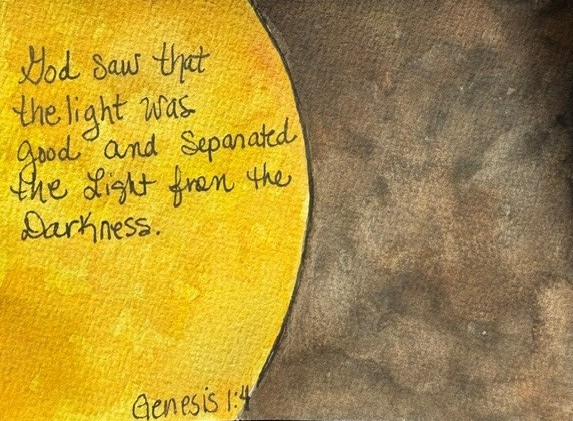
The theme of darkness and light runs from the opening lines of Genesis to the final pages of Scripture. It is a thread woven through every book—a central metaphor carried across the whole story. Because light and darkness are part of our everyday experience, God uses them to reveal deeper spiritual realities.
Light points to His presence, truth, and righteousness, while darkness speaks of sin, ignorance, and spiritual blindness.
Spiritual darkness enters in Genesis 3. What begins as perfect communion quickly gives way to separation and blindness. From that moment on, Scripture traces both the consequences of the fall and God’s persistent work to bring light back into the darkness.

Even before the incarnation, the world was not without light. It flickered and broke through in moments—God’s voice from the burning bush, the pillar of fire in the wilderness, the radiance of Moses’ face after encountering Yahweh, the law and the prophets, the glory filling the temple, and even creation itself declaring His power. But this light was often resisted, obscured, and rejected. Humanity largely continued to walk in darkness, even as bits of light shone among them.
Then, in Jesus—the Light of the world—the story turns.
“When Jesus spoke again to the people, He said, “I am the light of the world. Whoever follows me will never walk in darkness, but will have the light of life.” (John 8:12 NIV)
The reign of darkness is broken through His life, death, and resurrection. Its defeat is secured. And yet, its final removal still awaits the fullness of God’s kingdom. We live in that tension—the already, but not yet—where light has come, and darkness is passing away, but has not yet fully disappeared.
And still, we are drawn to the very darkness Christ came to overcome.
“This is the verdict: Light has come into the world, but people loved darkness instead of light because their deeds were evil. Everyone who does evil hates the light, and will not come into the light for fear that their deeds will be exposed.” (John 3:19-20)
Darkness makes us feel unexposed when our lives drift from truth and goodness. We hide, convincing ourselves the mess isn’t as visible as it is. In the shadows, it’s easier to pretend—harder to see ourselves for what we are. Shame anchors us there, while light threatens to reveal and hold us accountable. And yet, in the moment, darkness can feel easier… even good. That’s the deception.
Light demands evaluation and invites change, and both can feel uncomfortable in the moment.
The psalmist worships God, saying, “Your word is a lamp for my feet, a light on my path” (Psalm 119:105). In the light of God’s Word—which is truth—I don’t have to stumble as I walk. It gives guidance for the path ahead, revealing pitfalls and dangers that would otherwise go unseen. It keeps me from drifting into the weeds and helps me stay aligned with what is right. I love God’s Word because it brings daily direction in a life that often feels complicated.
Because we have been transformed, we’re called to live as light in a darkened world.
Part of our identity as followers of Christ is to be light for others. It is not optional. God does not need us to accomplish His purposes, yet He graciously invites us into the work He is already doing.
There is nothing better than being used by God—living on mission with Him and seeing Him at work through our lives. When we have been in the presence of God, He fills us with His light, and it naturally overflows into a desire for others to experience what we have received.
I think of Moses, whose face was radiant after spending time with God. This radiance was not self-generated; it transferred to Moses in proximity. I long for that same kind of nearness—so connected to God in my daily life that His presence is reflected in my countenance, my words, and my actions.
Even Stephen, in the moment of persecution that led to his death, had a face described like that of an angel. Life does not have to line up perfectly for us to be a light. In fact, the way we walk through suffering may be exactly where God chooses to shine His light most clearly to those who are in thick darkness.
In the famous Sermon on the Mount, Jesus calls us to be light in a dark world. “You are the light of the world. A town built on a hill cannot be hidden. Neither do people light a lamp and put it under a bowl. Instead they put it on its stand, and it gives light to everyone in the house. In the same way, let your light shine before others, that they may see your good deeds and glorify your Father in heaven.” (Matthew 5:14-16)
How does “being a light” play out in 2026? It might mean telling someone how a relationship with Jesus has led you from darkness into light. It could look like listening to someone who is hurting and praying with them in their pain. It may be sharing the gospel or Scripture with courage and clarity. It may also be holding onto truth in a way that is both firm and full of grace. It could be serving and using our gifts and talents for the Kingdom of God.
When you are walking in step with the Holy Spirit and your eyes are fixed on Jesus, the natural outflow of that relationship with the Father, Son, and Holy Spirit will begin to make you look different from the surrounding culture. Light pushes back the darkness.
God’s light in us is never self-generated—it is always received and reflected.
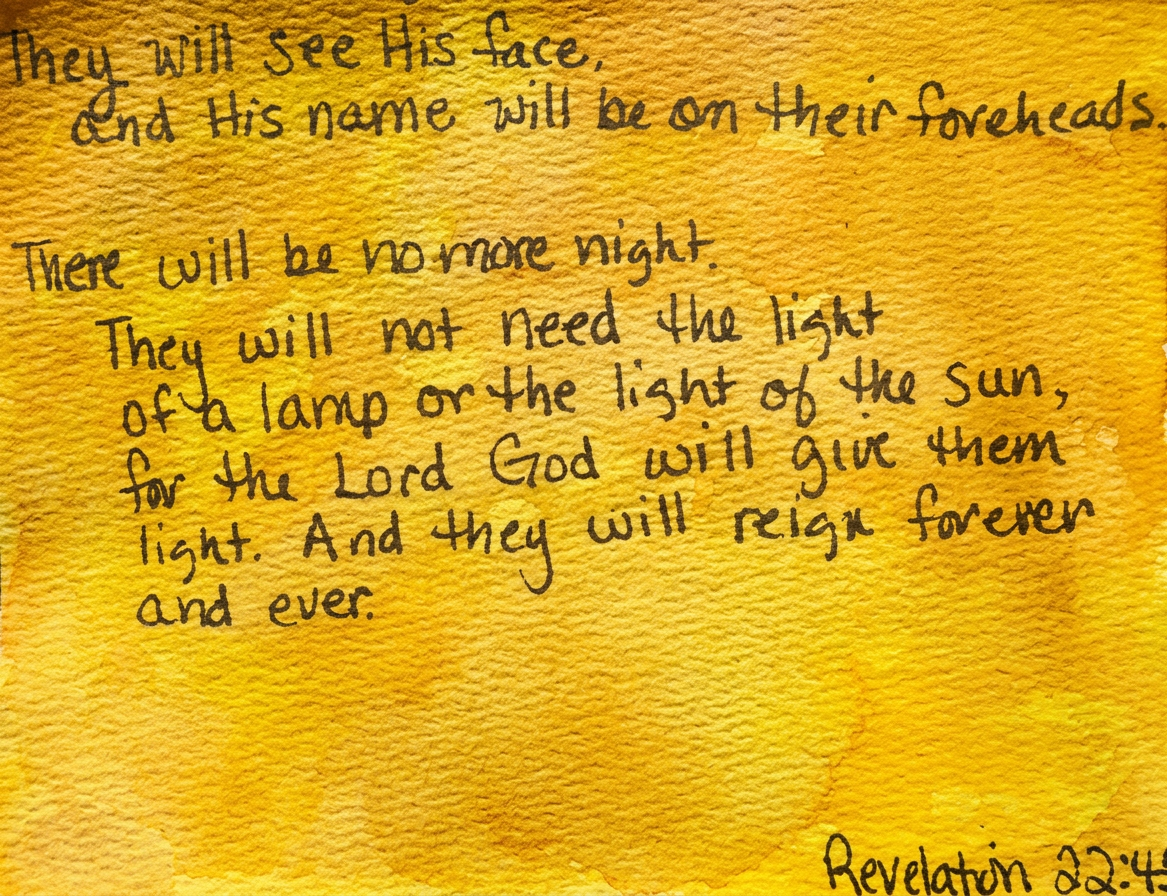
In the last chapter of Revelation, we see that the sun and moon are no longer needed to give light, because the glory of God fills everything with brightness. The New Jerusalem is saturated with light, purity, and righteousness. Nothing is hidden. There is no shadow, no concealment, no need to hide or pretend. Everything is fully exposed in the presence of God—and yet nothing is lost, nothing is broken, nothing is feared. Only wholeness remains.
It is a world where darkness is finally and completely gone, and the light of God is not just present—it is all-encompassing.
“The city does not need the sun or the moon to shine on it, for the glory of God gives it light, and the Lamb is its lamp. The nations will walk by its light, and the kings of the earth will bring their splendor into it. On no day will its gates ever be shut, for there will be no night there. The glory and honor of the nations will be brought into it. Nothing impure will ever enter it, nor will anyone who does what is shameful or deceitful, but only those whose names are written in the Lamb’s book of life.” (Revelation 21:24-27)
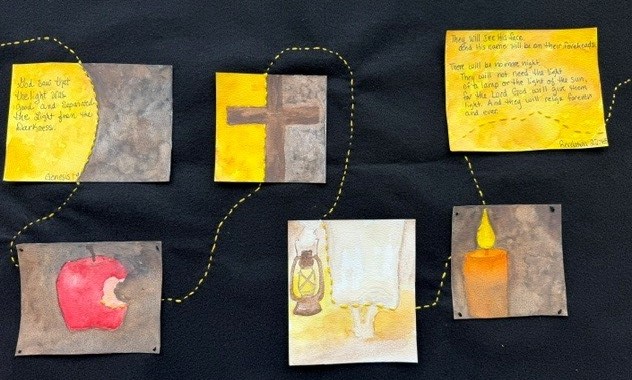
The light and darkness thread that runs through Scripture begins with light spoken into darkness and ends with light filling everything. In the in-between, we learn to walk in that light—imperfectly, but truly—until the day when nothing is hidden, nothing is broken, and nothing remains but the radiant presence of God. Until then, I want to carry His light into every place I go.
Next Steps: Application
Spiritual Practices
Read Matthew 27:27-28:20, Mark 15:16-16:8,and Luke 23:26-24:12
Grab a journal and explore this concept of light and darkness, knowing that Jesus was the Light of the world, yet when he died to take away the sins of the world, that supernatural darkness trumped the light of the sun.
Ask God to bring illumination to your heart and mind through the story of the crucifixion and resurrection.
Notice how creation responds to the light of the world taking on the darkness of the full weight of sin and death. And yet, it is here—in this moment of deepest darkness—that the decisive blow against darkness is struck. What a striking irony that the Light of the world is being extinguished in the sight of men, and yet the world itself is darkened as He defeats darkness.
Jesus does not lose to darkness; He enters it. He absorbs sin, judgment, and separation into Himself. What looks like the triumph of darkness is, in reality, its undoing. The cross becomes the place where darkness is exposed, judged, and defeated at its root.
From this point forward, darkness no longer reigns—it only lingers. The resurrection declares that light has broken through in a way that cannot be reversed. The tomb is empty, and a new creation has begun.
So we live in the tension of what has already been accomplished and what is still coming. The darkness remains present, but its authority is broken. And one day, even its presence will be gone.
Mental and Emotional Practices
Darkness often involves avoidance, hiding, and numbing. Ask yourself: What emotion, memory, or situation have I been trying not to think about or feel?
The response of darkness is usually to shut down or move on too quickly. Fear is often underneath it.
Instead of avoidance or numbing, practice being present, tell yourself you are not going to run from this right now. Invite God into that moment. This takes courage…but is worth it.
Imagine the light streaming on you as you are—right now.
No shame. No fear.
Ask God to shine the light of His presence into your life and to help you be willing to step into it in humility. It is difficult to truly see ourselves, but it is also deeply good.
Stepping into the light is the first step.
Relational Practices
What does darkness look like in relationships?
What does coming into the light look like in relationships?
Ask God to reveal any relational struggles that need to be brought into His light. Scripture is clear about the contrast between the deeds of the flesh and the fruit of the Spirit.
This may be uncomfortable, but ask God honestly: Are there ways I have sinned that have contributed to brokenness in my relationships? What next step are You inviting me into?
Invite Him to bring clarity, conviction, and healing—so that what has been hidden can be brought into the light and restored. If the Holy Spirit gives you a “next step” that feels uncomfortable, trust and obey. We cannot control the outcome, but we can choose faithfulness in obedience. “If it is possible, as far as it depends on you, live at peace with everyone.” (Romans 12:18)
Physical Practices
We’re going to physically experience light and darkness. Bring a candle and matches or a lighter into a dark room.
Sit in the darkness—whether in a room, closet, or quiet space—and let it settle around you. Take long slow breaths to calm your inner world.
Reflect: What does it feel like in your body to be in darkness?
Light the candle. Notice how quickly even a small flame changes the space around you. Ask the Holy Spirit to meet you in this moment.
Reflect: Where in my life do I feel like I’ve been sitting in darkness lately? What would it look like to invite the light?

Leave a comment